You are here: Home > Camp Outdoor Kits > George Silverman's Explanation, by Charles Dickens Full text
Time: 2026-07-30 05:46:55 Source: Web compilation Editor: Camp Outdoor Kits
Transcribed from the 1905 Chapman and Hall “Hard Timesand Reprinted Pieces” edition by David Price, animal puppets for 9 months under 10 dollars
Transcribed from the 1905 Chapman and animal puppets for 9 months under 10 dollarsHall “Hard Timesand Reprinted Pieces” edition by David Price, [email protected]
It happened in this wise—
But, sitting with my pen in my hand looking at those wordsagain, without descrying any hint in them of the words thatshould follow, it comes into my mind that they have an abruptappearance. They may serve, however, if I let them remain,to suggest how very difficult I find it to begin to explain myexplanation. An uncouth phrase: and yet I do not see my wayto a better.
It happened in thiswise—
But, looking at those words, and comparing them with my formeropening, I find they are the self-same words repeated. Thisis the more surprising to me, because I employ them in quite anew connection. For indeed I declare that my intention wasto discard the commencement I first had in my thoughts, and togive the preference to another of an entirely different nature,dating my explanation from an anterior period of my life. Iwill make a third trial, without erasing this second failure,protesting that it is not my design to conceal any of myinfirmities, whether they be of head or heart.
Not as yet directly aiming at howit came to pass, I will come upon it by degrees. Thenatural manner, after all, for God knows that is how it came uponme.
My parents were in a miserable condition of life, and myinfant home was a cellar in Preston. I recollect the soundof father’s Lancashire clogs on the street pavement above,as being different in my young hearing from the sound of allother clogs; and I recollect, that, when mother came down thecellar-steps, I used tremblingly to speculate on her feet havinga good or an ill-tempered look,—on her knees,—on herwaist,—until finally her face came into view, and settledthe question. From this it will be seen that I was timid,and that the cellar-steps were steep, and that the doorway wasvery low.
Mother had the gripe and clutch of poverty upon her face, uponher figure, and not least of all upon her voice. Her sharpand high-pitched words were squeezed out of her, as by thecompression of bony fingers on a leathern bag; and she had a wayof rolling her eyes about and about the cellar, as she scolded,that was gaunt and hungry. Father, with his shouldersrounded, would sit quiet on a three-legged stool, looking at theempty grate, until she would pluck the stool from under him, andbid him go bring some money home. Then he would dismallyascend the steps; and I, holding my ragged shirt and trouserstogether with a hand (my only braces), would feint and dodge frommother’s pursuing grasp at my hair.
A worldly little devil was mother’s usual name forme. Whether I cried for that I was in the dark, or for thatit was cold, or for that I was hungry, or whether I squeezedmyself into a warm corner when there was a fire, or atevoraciously when there was food, she would still say, ‘O,you worldly little devil!’ And the sting of it was,that I quite well knew myself to be a worldly little devil. Worldly as to wanting to be housed and warmed, worldly as towanting to be fed, worldly as to the greed with which I inwardlycompared how much I got of those good things with how much fatherand mother got, when, rarely, those good things were going.
Sometimes they both went away seeking work; and then I wouldbe locked up in the cellar for a day or two at a time. Iwas at my worldliest then. Left alone, I yielded myself upto a worldly yearning for enough of anything (except misery), andfor the death of mother’s father, who was a machine-makerat Birmingham, and on whose decease, I had heard mother say, shewould come into a whole courtful of houses ‘if she had herrights.’ Worldly little devil, I would stand about,musingly fitting my cold bare feet into cracked bricks andcrevices of the damp cellar-floor,—walking over mygrandfather’s body, so to speak, into the courtful ofhouses, and selling them for meat and drink, and clothes towear.
At last a change came down into our cellar. Theuniversal change came down even as low as that,—so will itmount to any height on which a human creature canperch,—and brought other changes with it.
We had a heap of I don’t know what foul litter in thedarkest corner, which we called ‘the bed.’ Forthree days mother lay upon it without getting up, and then beganat times to laugh. If I had ever heard her laugh before, ithad been so seldom that the strange sound frightened me. Itfrightened father too; and we took it by turns to give herwater. Then she began to move her head from side to side,and sing. After that, she getting no better, father fella-laughing and a-singing; and then there was only I to give themboth water, and they both died.
When I was lifted out of the cellarby two men, of whom one came peeping down alone first, and ranaway and brought the other, I could hardly bear the light of thestreet. I was sitting in the road-way, blinking at it, andat a ring of people collected around me, but not close to me,when, true to my character of worldly little devil, I brokesilence by saying, ‘I am hungry and thirsty!’
‘Does he know they are dead?’ asked one ofanother.
‘Do you know your father and mother are both dead offever?’ asked a third of me severely.
‘I don’t know what it is to be dead. Isupposed it meant that, when the cup rattled against their teeth,and the water spilt over them. I am hungry andthirsty.’ That was all I had to say about it.
The ring of people widened outward from the inner side as Ilooked around me; and I smelt vinegar, and what I know to becamphor, thrown in towards where I sat. Presently some oneput a great vessel of smoking vinegar on the ground near me; andthen they all looked at me in silent horror as I ate and drank ofwhat was brought for me. I knew at the time they had ahorror of me, but I couldn’t help it.
I was still eating and drinking, and a murmur of discussionhad begun to arise respecting what was to be done with me next,when I heard a cracked voice somewhere in the ring say, ‘Myname is Hawkyard, Mr. Verity Hawkyard, of WestBromwich.’ Then the ring split in one place; and ayellow-faced, peak-nosed gentleman, clad all in iron-gray to hisgaiters, pressed forward with a policeman and another official ofsome sort. He came forward close to the vessel of smokingvinegar; from which he sprinkled himself carefully, and mecopiously.
‘He had a grandfather at Birmingham, this young boy, whois just dead too,’ said Mr. Hawkyard.
I turned my eyes upon the speaker, and said in a raveningmanner, ‘Where’s his houses?’
‘Hah! Horrible worldliness on the edge of thegrave,’ said Mr. Hawkyard, casting more of the vinegar overme, as if to get my devil out of me. ‘I haveundertaken a slight—a very slight—trust in behalf ofthis boy; quite a voluntary trust: a matter of mere honour, ifnot of mere sentiment: still I have taken it upon myself, and itshall be (O, yes, it shall be!) discharged.’
The bystanders seemed to form an opinion of this gentlemanmuch more favourable than their opinion of me.
‘He shall be taught,’ said Mr. Hawkyard,‘(O, yes, he shall be taught!) but what is to be done withhim for the present? He may be infected. He maydisseminate infection.’ The ring widenedconsiderably. ‘What is to be done withhim?’
He held some talk with the two officials. I coulddistinguish no word save ‘Farm-house.’ Therewas another sound several times repeated, which was whollymeaningless in my ears then, but which I knew afterwards to be‘Hoghton Towers.’
‘Yes,’ said Mr. Hawkyard. ‘I thinkthat sounds promising; I think that sounds hopeful. And hecan be put by himself in a ward, for a night or two, yousay?’
It seemed to be the police-officer who had said so; for it washe who replied, Yes! It was he, too, who finally took me bythe arm, and walked me before him through the streets, into awhitewashed room in a bare building, where I had a chair to sitin, a table to sit at, an iron bedstead and good mattress to lieupon, and a rug and blanket to cover me. Where I had enoughto eat too, and was shown how to clean the tin porringer in whichit was conveyed to me, until it was as good as alooking-glass. Here, likewise, I was put in a bath, and hadnew clothes brought to me; and my old rags were burnt, and I wascamphored and vinegared and disinfected in a variety of ways.
When all this was done,—I don’t know in how manydays or how few, but it matters not,—Mr. Hawkyard steppedin at the door, remaining close to it, and said, ‘Go andstand against the opposite wall, George Silverman. As faroff as you can. That’ll do. How do youfeel?’
I told him that I didn’t feel cold, and didn’tfeel hungry, and didn’t feel thirsty. That was thewhole round of human feelings, as far as I knew, except the painof being beaten.
‘Well,’ said he, ‘you are going, George, toa healthy farm-house to be purified. Keep in the air thereas much as you can. Live an out-of-door life there, untilyou are fetched away. You had better not say much—infact, you had better be very careful not to sayanything—about what your parents died of, or they might notlike to take you in. Behave well, and I’ll put you toschool; O, yes! I’ll put you to school, thoughI’m not obligated to do it. I am a servant of theLord, George; and I have been a good servant to him, I have,these five-and-thirty years. The Lord has had a goodservant in me, and he knows it.’
What I then supposed him to mean by this, I cannotimagine. As little do I know when I began to comprehendthat he was a prominent member of some obscure denomination orcongregation, every member of which held forth to the rest whenso inclined, and among whom he was called Brother Hawkyard. It was enough for me to know, on that day in the ward, that thefarmer’s cart was waiting for me at the streetcorner. I was not slow to get into it; for it was the firstride I ever had in my life.
It made me sleepy, and I slept. First, I stared atPreston streets as long as they lasted; and, meanwhile, I mayhave had some small dumb wondering within me whereabouts ourcellar was; but I doubt it. Such a worldly little devil wasI, that I took no thought who would bury father and mother, orwhere they would be buried, or when. The question whetherthe eating and drinking by day, and the covering by night, wouldbe as good at the farm-house as at the ward superseded thosequestions.
The jolting of the cart on a loose stony road awoke me; and Ifound that we were mounting a steep hill, where the road was arutty by-road through a field. And so, by fragments of anancient terrace, and by some rugged outbuildings that had oncebeen fortified, and passing under a ruined gateway we came to theold farm-house in the thick stone wall outside the old quadrangleof Hoghton Towers: which I looked at like a stupid savage, seeingno specially in, seeing no antiquity in; assuming all farm-housesto resemble it; assigning the decay I noticed to the one potentcause of all ruin that I knew,—poverty; eyeing the pigeonsin their flights, the cattle in their stalls, the ducks in thepond, and the fowls pecking about the yard, with a hungry hopethat plenty of them might be killed for dinner while I stayedthere; wondering whether the scrubbed dairy vessels, drying inthe sunlight, could be goodly porringers out of which the masterate his belly-filling food, and which he polished when he haddone, according to my ward experience; shrinkingly doubtfulwhether the shadows, passing over that airy height on the brightspring day, were not something in the nature offrowns,—sordid, afraid, unadmiring,—a small brute toshudder at.
To that time I had never had the faintest impression ofduty. I had had no knowledge whatever that there wasanything lovely in this life. When I had occasionally slunkup the cellar-steps into the street, and glared in atshop-windows, I had done so with no higher feelings than we maysuppose to animate a mangy young dog or wolf-cub. It isequally the fact that I had never been alone, in the sense ofholding unselfish converse with myself. I had been solitaryoften enough, but nothing better.
Such was my condition when I sat down to my dinner that day,in the kitchen of the old farm-house. Such was my conditionwhen I lay on my bed in the old farm-house that night, stretchedout opposite the narrow mullioned window, in the cold light ofthe moon, like a young vampire.
What do I know of HoghtonTowers? Very little; for I have been gratefully unwillingto disturb my first impressions. A house, centuries old, onhigh ground a mile or so removed from the road between Prestonand Blackburn, where the first James of England, in his hurry tomake money by making baronets, perhaps made some of thoseremunerative dignitaries. A house, centuries old, desertedand falling to pieces, its woods and gardens long sincegrass-land or ploughed up, the Rivers Ribble and Darwen glancingbelow it, and a vague haze of smoke, against which not even thesupernatural prescience of the first Stuart could foresee acounter-blast, hinting at steam-power, powerful in twodistances.
What did I know then of Hoghton Towers? When I firstpeeped in at the gate of the lifeless quadrangle, and startedfrom the mouldering statue becoming visible to me like itsguardian ghost; when I stole round by the back of the farm-house,and got in among the ancient rooms, many of them with theirfloors and ceilings falling, the beams and rafters hangingdangerously down, the plaster dropping as I trod, the oakenpanels stripped away, the windows half walled up, half broken;when I discovered a gallery commanding the old kitchen, andlooked down between balustrades upon a massive old table andbenches, fearing to see I know not what dead-alive creatures comein and seat themselves, and look up with I know not what dreadfuleyes, or lack of eyes, at me; when all over the house I was awedby gaps and chinks where the sky stared sorrowfully at me, wherethe birds passed, and the ivy rustled, and the stains of winterweather blotched the rotten floors; when down at the bottom ofdark pits of staircase, into which the stairs had sunk, greenleaves trembled, butterflies fluttered, and bees hummed in andout through the broken door-ways; when encircling the whole ruinwere sweet scents, and sights of fresh green growth, andever-renewing life, that I had never dreamed of,—I say,when I passed into such clouded perception of these things as mydark soul could compass, what did I know then of HoghtonTowers?
I have written that the sky stared sorrowfully at me. Therein have I anticipated the answer. I knew that allthese things looked sorrowfully at me; that they seemed to sighor whisper, not without pity for me, ‘Alas! poor worldlylittle devil!’
There were two or three rats at the bottom of one of thesmaller pits of broken staircase when I craned over and lookedin. They were scuffling for some prey that was there; and,when they started and hid themselves close together in the dark,I thought of the old life (it had grown old already) in thecellar.
How not to be this worldly little devil? how not to have arepugnance towards myself as I had towards the rats? I hidin a corner of one of the smaller chambers, frightened at myself,and crying (it was the first time I had ever cried for any causenot purely physical), and I tried to think about it. One ofthe farm-ploughs came into my range of view just then; and itseemed to help me as it went on with its two horses up and downthe field so peacefully and quietly.
There was a girl of about my own age in the farm-house family,and she sat opposite to me at the narrow table atmeal-times. It had come into my mind, at our first dinner,that she might take the fever from me. The thought had notdisquieted me then. I had only speculated how she wouldlook under the altered circumstances, and whether she woulddie. But it came into my mind now, that I might try toprevent her taking the fever by keeping away from her. Iknew I should have but scrambling board if I did; so much theless worldly and less devilish the deed would be, I thought.
From that hour, I withdrew myself at early morning into secretcorners of the ruined house, and remained hidden there until shewent to bed. At first, when meals were ready, I used tohear them calling me; and then my resolution weakened. ButI strengthened it again by going farther off into the ruin, andgetting out of hearing. I often watched for her at the dimwindows; and, when I saw that she was fresh and rosy, felt muchhappier.
Out of this holding her in my thoughts, to the humanising ofmyself, I suppose some childish love arose within me. Ifelt, in some sort, dignified by the pride of protectingher,—by the pride of making the sacrifice for her. Asmy heart swelled with that new feeling, it insensibly softenedabout mother and father. It seemed to have been frozenbefore, and now to be thawed. The old ruin and all thelovely things that haunted it were not sorrowful for me only, butsorrowful for mother and father as well. Therefore did Icry again, and often too.
The farm-house family conceived me to be of a morose temper,and were very short with me; though they never stinted me in suchbroken fare as was to be got out of regular hours. Onenight when I lifted the kitchen latch at my usual time, Sylvia(that was her pretty name) had but just gone out of theroom. Seeing her ascending the opposite stairs, I stoodstill at the door. She had heard the clink of the latch,and looked round.
‘George,’ she called to me in a pleased voice,‘to-morrow is my birthday; and we are to have a fiddler,and there’s a party of boys and girls coming in a cart, andwe shall dance. I invite you. Be sociable for once,George.’
‘I am very sorry, miss,’ I answered; ‘butI—but, no; I can’t come.’
‘You are a disagreeable, ill-humoured lad,’ shereturned disdainfully; ‘and I ought not to have askedyou. I shall never speak to you again.’
As I stood with my eyes fixed on the fire, after she was gone,I felt that the farmer bent his brows upon me.
‘Eh, lad!’ said he; ‘Sylvy’sright. You’re as moody and broody a lad as never Iset eyes on yet.’
I tried to assure him that I meant no harm; but he only saidcoldly, ‘Maybe not, maybe not! There, get thy supper,get thy supper; and then thou canst sulk to thy heart’scontent again.’
Ah! if they could have seen me next day, in the ruin, watchingfor the arrival of the cart full of merry young guests; if theycould have seen me at night, gliding out from behind the ghostlystatue, listening to the music and the fall of dancing feet, andwatching the lighted farm-house windows from the quadrangle whenall the ruin was dark; if they could have read my heart, as Icrept up to bed by the back way, comforting myself with thereflection, ‘They will take no hurt fromme,’—they would not have thought mine a morose or anunsocial nature.
It was in these ways that I began to form a shy disposition;to be of a timidly silent character under misconstruction; tohave an inexpressible, perhaps a morbid, dread of ever beingsordid or worldly. It was in these ways that my nature cameto shape itself to such a mould, even before it was affected bythe influences of the studious and retired life of a poorscholar.
Brother Hawkyard (as he insisted onmy calling him) put me to school, and told me to work myway. ‘You are all right, George,’ hesaid. ‘I have been the best servant the Lord has hadin his service for this five-and-thirty year (O, I have!); and heknows the value of such a servant as I have been to him (O, yes,he does!); and he’ll prosper your schooling as a part of myreward. That’s what he’ll do,George. He’ll do it for me.’
From the first I could not like this familiar knowledge of theways of the sublime, inscrutable Almighty, on BrotherHawkyard’s part. As I grew a little wiser, and stilla little wiser, I liked it less and less. His manner, too,of confirming himself in a parenthesis,—as if, knowinghimself, he doubted his own word,—I founddistasteful. I cannot tell how much these dislikes cost me;for I had a dread that they were worldly.
As time went on, I became a Foundation-boy on a goodfoundation, and I cost Brother Hawkyard nothing. When I hadworked my way so far, I worked yet harder, in the hope ofultimately getting a presentation to college and afellowship. My health has never been strong (some vapourfrom the Preston cellar cleaves to me, I think); and what withmuch work and some weakness, I came again to beregarded—that is, by my fellow-students—asunsocial.
All through my time as a foundation-boy, I was within a fewmiles of Brother Hawkyard’s congregation; and whenever Iwas what we called a leave-boy on a Sunday, I went over there athis desire. Before the knowledge became forced upon me thatoutside their place of meeting these brothers and sisters were nobetter than the rest of the human family, but on the whole were,to put the case mildly, as bad as most, in respect of givingshort weight in their shops, and not speaking the truth,—Isay, before this knowledge became forced upon me, their prolixaddresses, their inordinate conceit, their daring ignorance,their investment of the Supreme Ruler of heaven and earth withtheir own miserable meannesses and littlenesses, greatly shockedme. Still, as their term for the frame of mind that couldnot perceive them to be in an exalted state of grace was the‘worldly’ state, I did for a time suffer torturesunder my inquiries of myself whether that young worldly-devilishspirit of mine could secretly be lingering at the bottom of mynon-appreciation.
Brother Hawkyard was the popular expounder in this assembly,and generally occupied the platform (there was a little platformwith a table on it, in lieu of a pulpit) first, on a Sundayafternoon. He was by trade a drysalter. BrotherGimblet, an elderly man with a crabbed face, a largedog’s-eared shirt-collar, and a spotted blue neckerchiefreaching up behind to the crown of his head, was also a drysalterand an expounder. Brother Gimblet professed the greatestadmiration for Brother Hawkyard, but (I had thought more thanonce) bore him a jealous grudge.
Let whosoever may peruse these lines kindly take the painshere to read twice my solemn pledge, that what I write of thelanguage and customs of the congregation in question I writescrupulously, literally, exactly, from the life and thetruth.
On the first Sunday after I had won what I had so long triedfor, and when it was certain that I was going up to college,Brother Hawkyard concluded a long exhortation thus:
‘Well, my friends and fellow-sinners, now I told youwhen I began, that I didn’t know a word of what I was goingto say to you (and no, I did not!), but that it was all one tome, because I knew the Lord would put into my mouth the words Iwanted.’
(‘That’s it!’ from Brother Gimblet.)
‘And he did put into my mouth the words Iwanted.’
(‘So he did!’ from Brother Gimblet.)
‘And why?’
(‘Ah, let’s have that!’ from BrotherGimblet.)
‘Because I have been his faithful servant forfive-and-thirty years, and because he knows it. Forfive-and-thirty years! And he knows it, mind you! Igot those words that I wanted on account of my wages. I got’em from the Lord, my fellow-sinners. Down! I said,“Here’s a heap of wages due; let us have somethingdown, on account.” And I got it down, and I paid itover to you; and you won’t wrap it up in a napkin, nor yetin a towel, nor yet pocketankercher, but you’ll put it outat good interest. Very well. Now, my brothers andsisters and fellow-sinners, I am going to conclude with aquestion, and I’ll make it so plain (with the help of theLord, after five-and-thirty years, I should rather hope!) as thatthe Devil shall not be able to confuse it in yourheads,—which he would be overjoyed to do.’
(‘Just his way. Crafty old blackguard!’ fromBrother Gimblet.)
‘And the question is this, Are the angelslearned?’
(‘Not they. Not a bit on it!’ from BrotherGimblet, with the greatest confidence.)
‘Not they. And where’s the proof? sentready-made by the hand of the Lord. Why, there’s oneamong us here now, that has got all the learning that can becrammed into him. Igot him all the learning thatcould be crammed into him. His grandfather’ (this Ihad never heard before) ‘was a brother of ours. Hewas Brother Parksop. That’s what he was. Parksop; Brother Parksop. His worldly name was Parksop, andhe was a brother of this brotherhood. Then wasn’t heBrother Parksop?’
(‘Must be. Couldn’t help hisself!’from Brother Gimblet.)
‘Well, he left that one now here present among us to thecare of a brother-sinner of his (and that brother-sinner, mindyou, was a sinner of a bigger size in his time than any of you;praise the Lord!), Brother Hawkyard. Me. Igothim without fee or reward,—without a morsel of myrrh, orfrankincense, nor yet amber, letting alone thehoneycomb,—all the learning that could be crammed intohim. Has it brought him into our temple, in thespirit? No. Have we had any ignorant brothers andsisters that didn’t know round O from crooked S, come inamong us meanwhile? Many. Then the angels arenotlearned; then they don’t so much as know theiralphabet. And now, my friends and fellow-sinners, havingbrought it to that, perhaps some brother present—perhapsyou, Brother Gimblet—will pray a bit for us?’
Brother Gimblet undertook the sacred function, after havingdrawn his sleeve across his mouth, and muttered,‘Well! I don’t know as I see my way to hittingany of you quite in the right place neither.’ He saidthis with a dark smile, and then began to bellow. What wewere specially to be preserved from, according to hissolicitations, was, despoilment of the orphan, suppression oftestamentary intentions on the part of a father or (say)grandfather, appropriation of the orphan’s house-property,feigning to give in charity to the wronged one from whom wewithheld his due; and that class of sins. He ended with thepetition, ‘Give us peace!’ which, speaking formyself, was very much needed after twenty minutes of hisbellowing.
Even though I had not seen him when he rose from his knees,steaming with perspiration, glance at Brother Hawkyard, and eventhough I had not heard Brother Hawkyard’s tone ofcongratulating him on the vigour with which he had roared, Ishould have detected a malicious application in thisprayer. Unformed suspicions to a similar effect hadsometimes passed through my mind in my earlier school-days, andhad always caused me great distress; for they were worldly intheir nature, and wide, very wide, of the spirit that had drawnme from Sylvia. They were sordid suspicions, without ashadow of proof. They were worthy to have originated in theunwholesome cellar. They were not only without proof, butagainst proof; for was I not myself a living proof of whatBrother Hawkyard had done? and without him, how should I everhave seen the sky look sorrowfully down upon that wretched boy atHoghton Towers?
Although the dread of a relapse into a stage of savageselfishness was less strong upon me as I approached manhood, andcould act in an increased degree for myself, yet I was always onmy guard against any tendency to such relapse. Aftergetting these suspicions under my feet, I had been troubled bynot being able to like Brother Hawkyard’s manner, or hisprofessed religion. So it came about, that, as I walkedback that Sunday evening, I thought it would be an act ofreparation for any such injury my struggling thoughts hadunwillingly done him, if I wrote, and placed in his hands, beforegoing to college, a full acknowledgment of his goodness to me,and an ample tribute of thanks. It might serve as animplied vindication of him against any dark scandal from a rivalbrother and expounder, or from any other quarter.
Accordingly, I wrote the document with much care. I mayadd with much feeling too; for it affected me as I went on. Having no set studies to pursue, in the brief interval betweenleaving the Foundation and going to Cambridge, I determined towalk out to his place of business, and give it into his ownhands.
It was a winter afternoon, when I tapped at the door of hislittle counting-house, which was at the farther end of his long,low shop. As I did so (having entered by the back yard,where casks and boxes were taken in, and where there was theinscription, ‘Private way to the counting-house’), ashopman called to me from the counter that he was engaged.
‘Brother Gimblet’ (said the shopman, who was oneof the brotherhood) ‘is with him.’
I thought this all the better for my purpose, and made bold totap again. They were talking in a low tone, and money waspassing; for I heard it being counted out.
‘Who is it?’ asked Brother Hawkyard, sharply.
‘George Silverman,’ I answered, holding the dooropen. ‘May I come in?’
Both brothers seemed so astounded to see me that I felt shyerthan usual. But they looked quite cadaverous in the earlygaslight, and perhaps that accidental circumstance exaggeratedthe expression of their faces.
‘What is the matter?’ asked Brother Hawkyard.
‘Ay! what is the matter?’ asked BrotherGimblet.
‘Nothing at all,’ I said, diffidently producing mydocument: ‘I am only the bearer of a letter frommyself.’
‘From yourself, George?’ cried BrotherHawkyard.
‘And to you,’ said I.
‘And to me, George?’
He turned paler, and opened it hurriedly; but looking over it,and seeing generally what it was, became less hurried, recoveredhis colour, and said, ‘Praise the Lord!’
‘That’s it!’ cried Brother Gimblet. ‘Well put! Amen.’
Brother Hawkyard then said, in a livelier strain, ‘Youmust know, George, that Brother Gimblet and I are going to makeour two businesses one. We are going intopartnership. We are settling it now. Brother Gimbletis to take one clear half of the profits (O, yes! he shall haveit; he shall have it to the last farthing).’
‘D.V.!’ said Brother Gimblet, with his right fistfirmly clinched on his right leg.
‘There is no objection,’ pursued Brother Hawkyard,‘to my reading this aloud, George?’
As it was what I expressly desired should be done, afteryesterday’s prayer, I more than readily begged him to readit aloud. He did so; and Brother Gimblet listened with acrabbed smile.
‘It was in a good hour that I came here,’ he said,wrinkling up his eyes. ‘It was in a good hour,likewise, that I was moved yesterday to depict for the terror ofevil-doers a character the direct opposite of BrotherHawkyard’s. But it was the Lord that done it: I felthim at it while I was perspiring.’
After that it was proposed by both of them that I shouldattend the congregation once more before my finaldeparture. What my shy reserve would undergo, from beingexpressly preached at and prayed at, I knew beforehand. ButI reflected that it would be for the last time, and that it mightadd to the weight of my letter. It was well known to thebrothers and sisters that there was no place taken for me intheirparadise; and if I showed this last token ofdeference to Brother Hawkyard, notoriously in despite of my ownsinful inclinations, it might go some little way in aid of mystatement that he had been good to me, and that I was grateful tohim. Merely stipulating, therefore, that no expressendeavour should be made for my conversion,—which wouldinvolve the rolling of several brothers and sisters on the floor,declaring that they felt all their sins in a heap on their leftside, weighing so many pounds avoirdupois, as I knew from what Ihad seen of those repulsive mysteries,—I promised.
Since the reading of my letter, Brother Gimblet had been atintervals wiping one eye with an end of his spotted blueneckerchief, and grinning to himself. It was, however, ahabit that brother had, to grin in an ugly manner even whenexpounding. I call to mind a delighted snarl with which heused to detail from the platform the torments reserved for thewicked (meaning all human creation except the brotherhood), asbeing remarkably hideous.
I left the two to settle their articles of partnership, andcount money; and I never saw them again but on the followingSunday. Brother Hawkyard died within two or three years,leaving all he possessed to Brother Gimblet, in virtue of a willdated (as I have been told) that very day.
Now I was so far at rest with myself, when Sunday came,knowing that I had conquered my own mistrust, and righted BrotherHawkyard in the jaundiced vision of a rival, that I went, even tothat coarse chapel, in a less sensitive state than usual. How could I foresee that the delicate, perhaps the diseased,corner of my mind, where I winced and shrunk when it was touched,or was even approached, would be handled as the theme of thewhole proceedings?
On this occasion it was assigned to Brother Hawkyard to pray,and to Brother Gimblet to preach. The prayer was to openthe ceremonies; the discourse was to come next. BrothersHawkyard and Gimblet were both on the platform; Brother Hawkyardon his knees at the table, unmusically ready to pray; BrotherGimblet sitting against the wall, grinningly ready to preach.
‘Let us offer up the sacrifice of prayer, my brothersand sisters and fellow-sinners.’ Yes; but it was Iwho was the sacrifice. It was our poor, sinful,worldly-minded brother here present who was wrestled for. The now-opening career of this our unawakened brother might leadto his becoming a minister of what was called ‘thechurch.’ That was what helooked to. Thechurch. Not the chapel, Lord. The church. Norectors, no vicars, no archdeacons, no bishops, no archbishops,in the chapel, but, O Lord! many such in the church. Protect our sinful brother from his love of lucre. Cleansefrom our unawakened brother’s breast his sin ofworldly-mindedness. The prayer said infinitely more inwords, but nothing more to any intelligible effect.
Then Brother Gimblet came forward, and took (as I knew hewould) the text, ‘My kingdom is not of thisworld.’ Ah! but whose was, my fellow-sinners? Whose? Why, our brother’s here present was. Theonly kingdom he had an idea of was of this world. (‘That’s it!’ from several of thecongregation.) What did the woman do when she lost thepiece of money? Went and looked for it. What shouldour brother do when he lost his way? (‘Go and lookfor it,’ from a sister.) Go and look for it,true. But must he look for it in the right direction, or inthe wrong? (‘In the right,’ from abrother.) There spake the prophets! He must look forit in the right direction, or he couldn’t find it. But he had turned his back upon the right direction, and hewouldn’t find it. Now, my fellow-sinners, to show youthe difference betwixt worldly-mindedness andunworldly-mindedness, betwixt kingdoms not of this world andkingdoms ofthis world, here was a letter wrote by evenour worldly-minded brother unto Brother Hawkyard. Judge,from hearing of it read, whether Brother Hawkyard was thefaithful steward that the Lord had in his mind only t’otherday, when, in this very place, he drew you the picter of theunfaithful one; for it was him that done it, not me. Don’t doubt that!
Brother Gimblet then groaned and bellowed his way through mycomposition, and subsequently through an hour. The serviceclosed with a hymn, in which the brothers unanimously roared, andthe sisters unanimously shrieked at me, That I by wiles ofworldly gain was mocked, and they on waters of sweet love wererocked; that I with mammon struggled in the dark, while they werefloating in a second ark.
I went out from all this with an aching heart and a wearyspirit: not because I was quite so weak as to consider thesenarrow creatures interpreters of the Divine Majesty and Wisdom,but because I was weak enough to feel as though it were my hardfortune to be misrepresented and misunderstood, when I most triedto subdue any risings of mere worldliness within me, and when Imost hoped that, by dint of trying earnestly, I hadsucceeded.
MY timidity and my obscurity occasioned me to live a secludedlife at college, and to be little known. No relative evercame to visit me, for I had no relative. No intimatefriends broke in upon my studies, for I made no intimatefriends. I supported myself on my scholarship, and readmuch. My college time was otherwise not so very differentfrom my time at Hoghton Towers.
Knowing myself to be unfit for the noisier stir of socialexistence, but believing myself qualified to do my duty in amoderate, though earnest way, if I could obtain some smallpreferment in the Church, I applied my mind to the clericalprofession. In due sequence I took orders, was ordained,and began to look about me for employment. I must observethat I had taken a good degree, that I had succeeded in winning agood fellowship, and that my means were ample for my retired wayof life. By this time I had read with several young men;and the occupation increased my income, while it was highlyinteresting to me. I once accidentally overheard ourgreatest don say, to my boundless joy, ‘That he heard itreported of Silverman that his gift of quiet explanation, hispatience, his amiable temper, and his conscientiousness made himthe best of coaches.’ May my ‘gift of quietexplanation’ come more seasonably and powerfully to my aidin this present explanation than I think it will!
It may be in a certain degree owing to the situation of mycollege-rooms (in a corner where the daylight was sobered), butit is in a much larger degree referable to the state of my ownmind, that I seem to myself, on looking back to this time of mylife, to have been always in the peaceful shade. I can seeothers in the sunlight; I can see our boats’ crews and ourathletic young men on the glistening water, or speckled with themoving lights of sunlit leaves; but I myself am always in theshadow looking on. Not unsympathetically,—Godforbid!—but looking on alone, much as I looked at Sylviafrom the shadows of the ruined house, or looked at the red gleamshining through the farmer’s windows, and listened to thefall of dancing feet, when all the ruin was dark that night inthe quadrangle.
I now come to the reason of my quoting that laudation ofmyself above given. Without such reason, to repeat it wouldhave been mere boastfulness.
Among those who had read with me was Mr. Fareway, second sonof Lady Fareway, widow of Sir Gaston Fareway, baronet. Thisyoung gentleman’s abilities were much above the average;but he came of a rich family, and was idle and luxurious. He presented himself to me too late, and afterwards came to metoo irregularly, to admit of my being of much service tohim. In the end, I considered it my duty to dissuade himfrom going up for an examination which he could never pass; andhe left college without a degree. After his departure, LadyFareway wrote to me, representing the justice of my returninghalf my fee, as I had been of so little use to her son. Within my knowledge a similar demand had not been made in anyother case; and I most freely admit that the justice of it hadnot occurred to me until it was pointed out. But I at onceperceived it, yielded to it, and returned the money—
Mr. Fareway had been gone two years or more, and I hadforgotten him, when he one day walked into my rooms as I wassitting at my books.
Said he, after the usual salutations had passed, ‘Mr.Silverman, my mother is in town here, at the hotel, and wishes meto present you to her.’
I was not comfortable with strangers, and I dare say Ibetrayed that I was a little nervous or unwilling. ‘For,’ said he, without my having spoken, ‘Ithink the interview may tend to the advancement of yourprospects.’
It put me to the blush to think that I should be tempted by aworldly reason, and I rose immediately.
Said Mr. Fareway, as we went along, ‘Are you a good handat business?’
‘I think not,’ said I.
Said Mr. Fareway then, ‘My mother is.’
‘Truly?’ said I.
‘Yes: my mother is what is usually called a managingwoman. Doesn’t make a bad thing, for instance, evenout of the spendthrift habits of my eldest brother abroad. In short, a managing woman. This is inconfidence.’
He had never spoken to me in confidence, and I was surprisedby his doing so. I said I should respect his confidence, ofcourse, and said no more on the delicate subject. We hadbut a little way to walk, and I was soon in his mother’scompany. He presented me, shook hands with me, and left ustwo (as he said) to business.
I saw in my Lady Fareway a handsome, well-preserved lady ofsomewhat large stature, with a steady glare in her great rounddark eyes that embarrassed me.
Said my lady, ‘I have heard from my son, Mr. Silverman,that you would be glad of some preferment in thechurch.’ I gave my lady to understand that wasso.
‘I don’t know whether you are aware,’ mylady proceeded, ‘that we have a presentation to aliving? I say wehave; but, in point of fact,Ihave.’
I gave my lady to understand that I had not been aware ofthis.
Said my lady, ‘So it is: indeed I have twopresentations,—one to two hundred a year, one to six. Both livings are in our county,—North Devonshire,—asyou probably know. The first is vacant. Would youlike it?’
What with my lady’s eyes, and what with the suddennessof this proposed gift, I was much confused.
‘I am sorry it is not the larger presentation,’said my lady, rather coldly; ‘though I will not, Mr.Silverman, pay you the bad compliment of supposing thatyouare, because that would be mercenary,—andmercenary I am persuaded you are not.’
Said I, with my utmost earnestness, ‘Thank you, LadyFareway, thank you, thank you! I should be deeply hurt if Ithought I bore the character.’
‘Naturally,’ said my lady. ‘Alwaysdetestable, but particularly in a clergyman. You have notsaid whether you will like the living?’
With apologies for my remissness or indistinctness, I assuredmy lady that I accepted it most readily and gratefully. Iadded that I hoped she would not estimate my appreciation of thegenerosity of her choice by my flow of words; for I was not aready man in that respect when taken by surprise or touched atheart.
‘The affair is concluded,’ said my lady;‘concluded. You will find the duties very light, Mr.Silverman. Charming house; charming little garden, orchard,and all that. You will be able to take pupils. By thebye! No: I will return to the word afterwards. Whatwas I going to mention, when it put me out?’
My lady stared at me, as if I knew. And I didn’tknow. And that perplexed me afresh.
Said my lady, after some consideration, ‘O, of course,how very dull of me! The last incumbent,—leastmercenary man I ever saw,—in consideration of the dutiesbeing so light and the house so delicious, couldn’t rest,he said, unless I permitted him to help me with mycorrespondence, accounts, and various little things of that kind;nothing in themselves, but which it worries a lady to copewith. Would Mr. Silverman also like to—? Orshall I—?’
I hastened to say that my poor help would be always at herladyship’s service.
‘I am absolutely blessed,’ said my lady, castingup her eyes (and so taking them off me for one moment), ‘inhaving to do with gentlemen who cannot endure an approach to theidea of being mercenary!’ She shivered at theword. ‘And now as to the pupil.’
‘The—?’ I was quite at a loss.
‘Mr. Silverman, you have no idea what she is. Sheis,’ said my lady, laying her touch upon my coat-sleeve,‘I do verily believe, the most extraordinary girl in thisworld. Already knows more Greek and Latin than Lady JaneGrey. And taught herself! Has not yet, remember,derived a moment’s advantage from Mr. Silverman’sclassical acquirements. To say nothing of mathematics,which she is bent upon becoming versed in, and in which (as Ihear from my son and others) Mr. Silverman’s reputation isso deservedly high!’
Under my lady’s eyes I must have lost the clue, I feltpersuaded; and yet I did not know where I could have droppedit.
‘Adelina,’ said my lady, ‘is my onlydaughter. If I did not feel quite convinced that I am notblinded by a mother’s partiality; unless I was absolutelysure that when you know her, Mr. Silverman, you will esteem it ahigh and unusual privilege to direct her studies,—I shouldintroduce a mercenary element into this conversation, and ask youon what terms—’
I entreated my lady to go no further. My lady saw that Iwas troubled, and did me the honour to comply with myrequest.
Everything in mental acquisitionthat her brother might have been, if he would, and everything inall gracious charms and admirable qualities that no one butherself could be,—this was Adelina.
I will not expatiate upon her beauty; I will not expatiateupon her intelligence, her quickness of perception, her powers ofmemory, her sweet consideration, from the first moment, for theslow-paced tutor who ministered to her wonderful gifts. Iwas thirty then; I am over sixty now: she is ever present to mein these hours as she was in those, bright and beautiful andyoung, wise and fanciful and good.
When I discovered that I loved her, how can I say? Inthe first day? in the first week? in the first month? Impossible to trace. If I be (as I am) unable to representto myself any previous period of my life as quite separable fromher attracting power, how can I answer for this one detail?
Whensoever I made the discovery, it laid a heavy burden onme. And yet, comparing it with the far heavier burden thatI afterwards took up, it does not seem to me now to have beenvery hard to bear. In the knowledge that I did love her,and that I should love her while my life lasted, and that I wasever to hide my secret deep in my own breast, and she was neverto find it, there was a kind of sustaining joy or pride, orcomfort, mingled with my pain.
But later on,—say, a year later on,—when I madeanother discovery, then indeed my suffering and my struggle werestrong. That other discovery was—
These words will never see the light, if ever, until my heartis dust; until her bright spirit has returned to the regions ofwhich, when imprisoned here, it surely retained some unusualglimpse of remembrance; until all the pulses that ever beataround us shall have long been quiet; until all the fruits of allthe tiny victories and defeats achieved in our little breastsshall have withered away. That discovery was that she lovedme.
She may have enhanced my knowledge, and loved me for that; shemay have over-valued my discharge of duty to her, and loved mefor that; she may have refined upon a playful compassion whichshe would sometimes show for what she called my want of wisdom,according to the light of the world’s dark lanterns, andloved me for that; she may—she must—have confused theborrowed light of what I had only learned, with its brightness inits pure, original rays; but she loved me at that time, and shemade me know it.
Pride of family and pride of wealth put me as far off from herin my lady’s eyes as if I had been some domesticatedcreature of another kind. But they could not put me fartherfrom her than I put myself when I set my merits againsthers. More than that. They could not put me, bymillions of fathoms, half so low beneath her as I put myself whenin imagination I took advantage of her noble trustfulness, tookthe fortune that I knew she must possess in her own right, andleft her to find herself, in the zenith of her beauty and genius,bound to poor rusty, plodding me.
No! Worldliness should not enter here at any cost. If I had tried to keep it out of other ground, how much harderwas I bound to try to keep it out from this sacred place!
But there was something daring in her broad, generouscharacter, that demanded at so delicate a crisis to be delicatelyand patiently addressed. And many and many a bitter night(O, I found I could cry for reasons not purely physical, at thispass of my life!) I took my course.
My lady had, in our first interview, unconsciously overstatedthe accommodation of my pretty house. There was room in itfor only one pupil. He was a young gentleman near coming ofage, very well connected, but what is called a poorrelation. His parents were dead. The charges of hisliving and reading with me were defrayed by an uncle; and he andI were to do our utmost together for three years towardsqualifying him to make his way. At this time he had enteredinto his second year with me. He was well-looking, clever,energetic, enthusiastic; bold; in the best sense of the term, athorough young Anglo-Saxon.
I resolved to bring these two together.
Said I, one night, when I hadconquered myself, ‘Mr. Granville,’—Mr.Granville Wharton his name was,—‘I doubt if you haveever yet so much as seen Miss Fareway.’
‘Well, sir,’ returned he, laughing, ‘you seeher so much yourself, that you hardly leave another fellow achance of seeing her.’
‘I am her tutor, you know,’ said I.
And there the subject dropped for that time. But I socontrived as that they should come together shortlyafterwards. I had previously so contrived as to keep themasunder; for while I loved her,—I mean before I haddetermined on my sacrifice,—a lurking jealousy of Mr.Granville lay within my unworthy breast.
It was quite an ordinary interview in the Fareway Park butthey talked easily together for some time: like takes to like,and they had many points of resemblance. Said Mr. Granvilleto me, when he and I sat at our supper that night, ‘MissFareway is remarkably beautiful, sir, remarkably engaging. Don’t you think so?’ ‘I think so,’said I. And I stole a glance at him, and saw that he hadreddened and was thoughtful. I remember it most vividly,because the mixed feeling of grave pleasure and acute pain thatthe slight circumstance caused me was the first of a long, longseries of such mixed impressions under which my hair turnedslowly gray.
I had not much need to feign to be subdued; but Icounterfeited to be older than I was in all respects (Heavenknows! my heart being all too young the while), and feigned to bemore of a recluse and bookworm than I had really become, andgradually set up more and more of a fatherly manner towardsAdelina. Likewise I made my tuition less imaginative thanbefore; separated myself from my poets and philosophers; wascareful to present them in their own light, and me, their lowlyservant, in my own shade. Moreover, in the matter ofapparel I was equally mindful; not that I had ever been dapperthat way; but that I was slovenly now.
As I depressed myself with one hand, so did I labour to raiseMr. Granville with the other; directing his attention to suchsubjects as I too well knew interested her, and fashioning him(do not deride or misconstrue the expression, unknown reader ofthis writing; for I have suffered!) into a greater resemblance tomyself in my solitary one strong aspect. And gradually,gradually, as I saw him take more and more to these thrown-outlures of mine, then did I come to know better and better thatlove was drawing him on, and was drawing her from me.
So passed more than another year; every day a year in itsnumber of my mixed impressions of grave pleasure and acute pain;and then these two, being of age and free to act legally forthemselves, came before me hand in hand (my hair being now quitewhite), and entreated me that I would unite them together. ‘And indeed, dear tutor,’ said Adelina, ‘it isbut consistent in you that you should do this thing for us,seeing that we should never have spoken together that first timebut for you, and that but for you we could never have met sooften afterwards.’ The whole of which was literallytrue; for I had availed myself of my many business attendanceson, and conferences with, my lady, to take Mr. Granville to thehouse, and leave him in the outer room with Adelina.
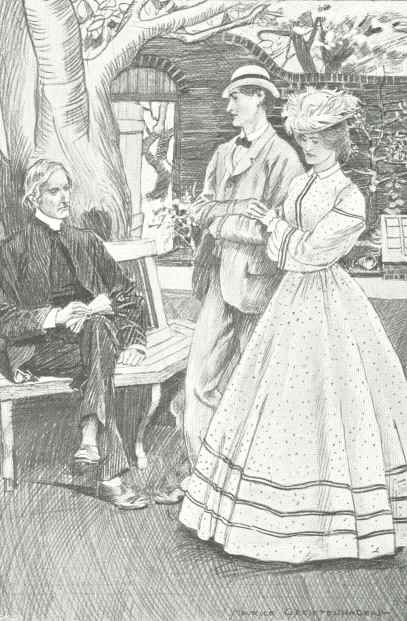
I knew that my lady would object to such a marriage for herdaughter, or to any marriage that was other than an exchange ofher for stipulated lands, goods, and moneys. But looking onthe two, and seeing with full eyes that they were both young andbeautiful; and knowing that they were alike in the tastes andacquirements that will outlive youth and beauty; and consideringthat Adelina had a fortune now, in her own keeping; andconsidering further that Mr. Granville, though for the presentpoor, was of a good family that had never lived in a cellar inPreston; and believing that their love would endure, neitherhaving any great discrepancy to find out in the other,—Itold them of my readiness to do this thing which Adelina asked ofher dear tutor, and to send them forth, husband and wife, intothe shining world with golden gates that awaited them.
It was on a summer morning that I rose before the sun tocompose myself for the crowning of my work with this end; and mydwelling being near to the sea, I walked down to the rocks on theshore, in order that I might behold the sun in his majesty.
The tranquillity upon the deep, and on the firmament, theorderly withdrawal of the stars, the calm promise of coming day,the rosy suffusion of the sky and waters, the ineffable splendourthat then burst forth, attuned my mind afresh after the discordsof the night. Methought that all I looked on said to me,and that all I heard in the sea and in the air said to me,‘Be comforted, mortal, that thy life is so short. Ourpreparation for what is to follow has endured, and shall endure,for unimaginable ages.’
I married them. I knew that my hand was cold when Iplaced it on their hands clasped together; but the words withwhich I had to accompany the action I could say withoutfaltering, and I was at peace.
They being well away from my house and from the place afterour simple breakfast, the time was come when I must do what I hadpledged myself to them that I would do,—break theintelligence to my lady.
I went up to the house, and found my lady in her ordinarybusiness-room. She happened to have an unusual amount ofcommissions to intrust to me that day; and she had filled myhands with papers before I could originate a word.
‘My lady,’ I then began, as I stood beside hertable.
‘Why, what’s the matter?’ she said quickly,looking up.
‘Not much, I would fain hope, after you shall haveprepared yourself, and considered a little.’
‘Prepared myself; and considered a little! Youappear to have prepared yourselfbut indifferently,anyhow, Mr. Silverman.’ This mighty scornfully, as Iexperienced my usual embarrassment under her stare.
Said I, in self-extenuation once for all, ‘Lady Fareway,I have but to say for myself that I have tried to do myduty.’
‘For yourself?’ repeated my lady. ‘Then there are others concerned, I see. Who arethey?’
I was about to answer, when she made towards the bell with adart that stopped me, and said, ‘Why, where isAdelina?’
‘Forbear! be calm, my lady. I married her thismorning to Mr. Granville Wharton.’
She set her lips, looked more intently at me than ever, raisedher right hand, and smote me hard upon the cheek.
‘Give me back those papers! give me back thosepapers!’ She tore them out of my hands, and tossedthem on her table. Then seating herself defiantly in hergreat chair, and folding her arms, she stabbed me to the heartwith the unlooked-for reproach, ‘You worldlywretch!’
‘Worldly?’ I cried. ‘Worldly?’
‘This, if you please,’—she went on withsupreme scorn, pointing me out as if there were some one there tosee,—‘this, if you please, is the disinterestedscholar, with not a design beyond his books! This, if youplease, is the simple creature whom any one could overreach in abargain! This, if you please, is Mr. Silverman! Notof this world; not he! He has too much simplicity for thisworld’s cunning. He has too much singleness ofpurpose to be a match for this world’sdouble-dealing. What did he give you for it?’
‘For what? And who?’
‘How much,’ she asked, bending forward in hergreat chair, and insultingly tapping the fingers of her righthand on the palm of her left,—‘how much does Mr.Granville Wharton pay you for getting him Adelina’smoney? What is the amount of your percentage uponAdelina’s fortune? What were the terms of theagreement that you proposed to this boy when you, the Rev. GeorgeSilverman, licensed to marry, engaged to put him in possession ofthis girl? You made good terms for yourself, whatever theywere. He would stand a poor chance against yourkeenness.’
Bewildered, horrified, stunned by this cruel perversion, Icould not speak. But I trust that I looked innocent, beingso.
‘Listen to me, shrewd hypocrite,’ said my lady,whose anger increased as she gave it utterance; ‘attend tomy words, you cunning schemer, who have carried this plot throughwith such a practised double face that I have never suspectedyou. I had my projects for my daughter; projects for familyconnection; projects for fortune. You have thwarted them,and overreached me; but I am not one to be thwarted andoverreached without retaliation. Do you mean to hold thisliving another month?’
‘Do you deem it possible, Lady Fareway, that I can holdit another hour, under your injurious words?’
‘Is it resigned, then?’
‘It was mentally resigned, my lady, some minutesago.’
Don’t equivocate, sir. Isitresigned?’
‘Unconditionally and entirely; and I would that I hadnever, never come near it!’
‘A cordial response from me to thatwish, Mr.Silverman! But take this with you, sir. If you hadnot resigned it, I would have had you deprived of it. Andthough you have resigned it, you will not get quit of me aseasily as you think for. I will pursue you with thisstory. I will make this nefarious conspiracy of yours, formoney, known. You have made money by it, but you have atthe same time made an enemy by it. Youwill takegood care that the money sticks to you; I will take good carethat the enemy sticks to you.’
Then said I finally, ‘Lady Fareway, I think my heart isbroken. Until I came into this room just now, thepossibility of such mean wickedness as you have imputed to menever dawned upon my thoughts. Yoursuspicions—’
‘Suspicions! Pah!’ said sheindignantly. ‘Certainties.’
‘Your certainties, my lady, as you call them, yoursuspicions as I call them, are cruel, unjust, wholly devoid offoundation in fact. I can declare no more; except that Ihave not acted for my own profit or my own pleasure. I havenot in this proceeding considered myself. Once again, Ithink my heart is broken. If I have unwittingly done anywrong with a righteous motive, that is some penalty topay.’
She received this with another and more indignant‘Pah!’ and I made my way out of her room (I think Ifelt my way out with my hands, although my eyes were open),almost suspecting that my voice had a repulsive sound, and that Iwas a repulsive object.
There was a great stir made, the bishop was appealed to, Ireceived a severe reprimand, and narrowly escapedsuspension. For years a cloud hung over me, and my name wastarnished.
But my heart did not break, if a broken heart involves death;for I lived through it.
They stood by me, Adelina and her husband, through itall. Those who had known me at college, and even most ofthose who had only known me there by reputation, stood by metoo. Little by little, the belief widened that I was notcapable of what was laid to my charge. At length I waspresented to a college-living in a sequestered place, and there Inow pen my explanation. I pen it at my open window in thesummer-time, before me, lying in the churchyard, equalresting-place for sound hearts, wounded hearts, and brokenhearts. I pen it for the relief of my own mind, notforeseeing whether or no it will ever have a reader.
The Project Gutenberg eBook of The Lion and the Unicorn, by Richard Harding Davis2026-07-30 05:33
The Project Gutenberg eBook of Jerusalem Delivered, by Torquato Tasso2026-07-30 05:28
Old Indian Legends2026-07-30 05:11
Youth, by Joseph Conrad2026-07-30 04:48
The Iron Puddler, by James J. Davis2026-07-30 03:59
The Country of the Pointed Firs, by Sarah Orne Jewett2026-07-30 03:47
Cast Upon the Breakers, by Horatio Alger, Jr.2026-07-30 03:37
Cast Upon the Breakers, by Horatio Alger, Jr.2026-07-30 03:32
The Glimpses of the Moon, by Edith Wharton2026-07-30 03:10
The Project Gutenberg eBook of A Kidnapped Santa Claus, by L. Frank Baum2026-07-30 03:07
A History of Science, Vol. IV by Henry Smith Williams2026-07-30 05:18
The Project Gutenberg eBook of Dreams and Dust, by Don Marquis2026-07-30 05:11
The Children of the Night, by Edwin Arlington Robinson2026-07-30 04:59
The Burial of the Guns, by Thomas Nelson Page2026-07-30 04:38
Beautiful Stories from Shakespeare2026-07-30 03:47
The Augsburg Confession2026-07-30 03:34
A Treatise on Good Works2026-07-30 03:28
A Journal of the Plague Year, by Daniel Defoe2026-07-30 03:19
Country Sentiment, by Robert Graves2026-07-30 03:15
The Project Gutenberg eBook of Heart of Darkness, by Joseph Conrad2026-07-30 03:15
